
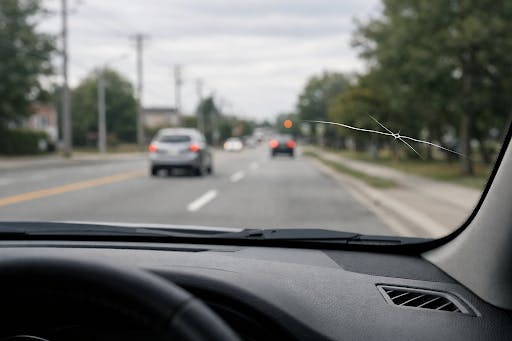
A cracked windscreen has a habit of appearing at exactly the wrong time. Often it’s just before an MOT, when you suddenly start noticing things you’ve been happily ignoring for months and wondering whether that crack is about to cause a fail.
So, will a cracked windscreen fail an MOT?
The short answer is yes, in some cases. Whether it fails depends on where the damage is, how large it is, and whether it affects what you can see while driving. MOT testers are not looking for perfection. They are assessing whether the windscreen allows safe, clear visibility.
This guide explains how cracked windscreens are assessed, what the size limits mean in practice, and what to look out for before MOT day.
Windscreen condition is assessed under the vision and visibility section of the MOT. The tester’s focus is straightforward: does the windscreen allow the driver a clear and unobstructed view of the road?
The official rules are set out in the UK Government’s MOT Inspection Manual for private passenger and light commercial vehicles. The guidance makes it clear that windscreen damage becomes a reason for rejection when it significantly affects the driver’s view of the road. Final decisions always rest with the MOT tester on the day.
In practical terms, testers look at:
The wiper-swept area is the part of the windscreen cleared by the wipers. Damage within this area is treated more seriously than damage outside it, because this is the area you rely on most in rain, spray, and poor weather.
If you are unsure whether damage sits in this zone, briefly activate your wipers and check what they cover. Any crack or chip inside that arc is relevant to the MOT assessment.
Damage outside the swept area is less likely to cause a failure, although it may still be recorded as an advisory if it looks likely to worsen.
These thresholds are not applied in isolation. The damage must also significantly affect visibility. In practice, this often comes down to distortion or glare rather than the crack itself, which is why similar-looking damage can sometimes receive different outcomes.
The driver’s line of sight is the central portion of the windscreen where your eyes naturally focus while driving. Damage here is assessed more strictly because even small defects can distract you or subtly distort what you see ahead.
A useful check is to sit in the driver’s seat and look through the windscreen rather than at it. If the crack repeatedly pulls your attention away from the road ahead, it is likely to concern the MOT tester as well.
From an MOT point of view, no. Chips and cracks are both classed as windscreen damage.
What matters is:
Cracks tend to be more problematic because they can spread and catch light, particularly at night or in wet conditions. A small, stable chip may pass, while a thin crack in the wrong place may not.
A cracked windscreen can still pass an MOT if:
In these situations, the tester may issue an advisory rather than a fail. An advisory is a warning, not reassurance. Windscreen damage can worsen faster than expected, especially with temperature changes or regular demister use.
When it comes to MOTs, timing matters. Small chips can sometimes be dealt with before they spread, but once a crack starts travelling across the glass, repair is rarely reliable, and replacement is usually the only sensible option.
We regularly see windscreens that were borderline weeks earlier worsen just before an MOT due to everyday driving and changes in temperature. That is why it makes sense to have windscreen damage assessed as soon as you notice it, rather than waiting until test day.
We handle both repairs and full replacements as part of our windscreen repair and replacement services, so whether the damage is still small or already spreading, there is a practical next step available.
If your MOT is approaching and you want certainty rather than guesswork, the simplest option is to have the windscreen checked properly before test day.
A windscreen does more than provide visibility. Modern windscreens are made from laminated safety glass, designed to stay bonded together if cracked rather than shattering. This reduces the risk of injury and helps maintain the structural integrity of the vehicle in a collision, as outlined in this overview of laminated glass construction.
Many vehicles also rely on cameras and sensors mounted to or near the windscreen. These support Advanced Driver Assistance Systems, such as lane departure warnings and automatic emergency braking. Independent research from the Insurance Institute for Highway Safety on advanced driver assistance systems shows that these technologies can reduce certain types of crashes when operating correctly.
Because these systems depend on clear visual input and accurate alignment, windscreen condition and correct installation matter not just for passing an MOT, but for everyday safety.
If your MOT is approaching, a quick check can save time and hassle.
Step 1: Sit in the driver’s seat in your usual driving position.
Step 2: Look through the windscreen and note where your eyes naturally focus.
Step 3: Identify whether any damage falls within the wiper-swept area.
Step 4: Check for distortion, glare, or distraction caused by the crack.
If anything looks borderline, it is better to have it assessed early rather than leave it to chance.
If you want to compare your own windscreen damage with real-world examples, our gallery of completed windscreen repairs and replacements shows the types of issues we deal with regularly.
This can help put what you are seeing on your own vehicle into context.
A cracked windscreen can fail an MOT, particularly when the damage:
If you are still unsure after checking the windscreen yourself, it is often easier to speak to someone who deals with this type of damage every day. Even a short conversation can clarify whether a repair is realistic or whether replacement is the smarter option before your MOT.
If you’d like advice on your specific windscreen damage or want to arrange an inspection, you can contact Apex Windscreens directly.