
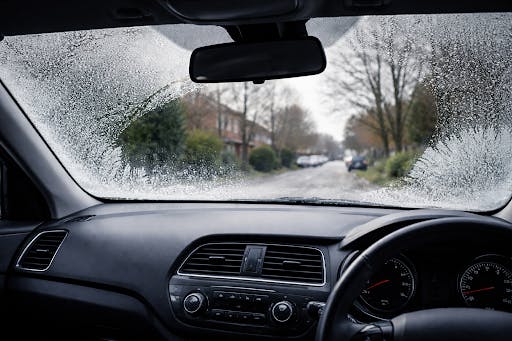
If your windscreen is freezing on the inside, it is rarely “just the weather”. It is a moisture problem. Cold glass simply reveals what is already happening inside the cabin: warm, damp air hitting a cold surface and turning into condensation. When temperatures drop far enough, condensation becomes frost.
A leaking windscreen often sits behind the same issue. Water gets in, the cabin stays damp, and the windscreen mists and then freezes from the inside. Deal with the moisture, and you usually deal with the freezing at the same time.
The sections below look at both problems together, because they are often linked: how to stop internal windscreen freezing and how to identify and fix a leaking windscreen properly.
Inside freezing happens when moisture in the cabin air reaches its dew point and condenses on cold glass, then freezes. Put simply, the dew point is the temperature at which air becomes saturated and condensation forms. That principle explains why windscreen mist freezes from the inside rather than the outside.
If you want a bit more of the science behind it, there is a clear explanation of dew point temperature and how condensation forms on cold surfaces in this ThoughtCo guide to the dew point.
In practice, the causes are usually straightforward and often overlap:
If the car smells damp, takes a long time to demist, or keeps misting up even on short journeys, excess moisture is almost always present.
This is the quickest win and the most commonly overlooked. If moisture stays in the car, the windscreen will keep freezing.
If carpets feel damp, they need to be dried properly. Even a few dry hours with doors open can make a noticeable difference.
Recirculation warms the cabin quickly, but it traps moisture.
A more effective routine is:
Both the Met Office and National Highways give similar advice for maintaining visibility in cold or damp conditions. Their guidance on driving in severe weather and travelling in fog highlights the importance of demisting and fresh airflow rather than trapping damp air.
Air conditioning does not just cool the cabin. It actively removes moisture from the air, which is why it is so effective at clearing mist even in cold weather.
If air conditioning seems to make little difference, it may need checking, but constant recirculation is often the bigger issue.
A film builds up on interior glass over time and holds moisture, making misting worse.
Clean:
Use a proper glass cleaner and a clean cloth. Avoid products that leave residue, as this encourages condensation.
If basic moisture control is in place and the windscreen still freezes inside regularly, this usually points to water entering the cabin somewhere. That brings us to windscreen leaks.
Windscreen leaks are not always obvious drips. Water often travels behind trim before it shows itself.
Common signs include:
In many cases, this builds up gradually rather than appearing overnight.
Start by checking:
Where moisture collects most heavily often points to the entry route.
From outside the vehicle, look for:
Avoid prodding seals with tools, as this can worsen the problem.
Not all wet carpets mean a leaking windscreen. Also check:
Blocked drains can force water into the cabin and mimic windscreen leaks, so it is worth ruling these out before focusing on the glass.
If possible:
If water appears quickly near the edges or pillars, the bonding or seal is likely compromised.
In practice, quick sealant fixes rarely last. If a windscreen has been poorly bonded, the appropriate remedy is usually a proper re-bond or, in some cases, replacement, depending on the condition of the glass and bonding area.
Smearing sealant around the outside often hides symptoms temporarily and can make proper repair more difficult later. It does not address the bonding surface, and water usually finds its way back in.
Windscreen sealing issues, replacement, and related checks form part of the day-to-day work we carry out through our windscreen repair and replacement services, so this is not something you have to diagnose alone.
If the windscreen is leaking or you are dealing with constant internal freezing, the simplest next step is to have the glass and seal assessed properly rather than chasing damp repeatedly. A straightforward inspection can confirm whether a repair or replacement is the more sensible option and stop the problem from returning.
Even once water ingress is resolved, moisture may remain in the cabin.
If you want a sense of the type of work involved, the Apex Windscreens gallery shows typical repair and replacement outcomes.
Inside windscreen freezing is a moisture problem. Stop the moisture, and the frost usually stops too.
Put simply, if moisture keeps returning, so will the freezing. Drying habits and ventilation help, but if water is getting in, the issue will persist until it is fixed properly.
Vehicle condition varies, and inspection is always recommended where water ingress is suspected. If you would like advice or want to arrange an inspection, you can contact Apex Windscreens directly and talk it through with someone who deals with these problems every day.